KHAOS hero artwork

KHAOS — Your Own Music. Your Own AI.

Consented, artist-owned AI models that pay the people whose work made them. A free-to-use toolkit that lets a musician train an AI model on their own catalogue, locally, on hardware they already own.

The model belongs to the artist.

A musician trains it on their own catalogue, on hardware they already own. The catalogue is theirs, so the consent question is answered before any training starts. Whatever the model makes carries attribution back to them.

Most of the response to AI in music has been open letters, consultations and lawsuits, all of it aimed at tools that were already built, on other people's work. A working alternative, built rather than argued for.

One

The Workshop

Free to use, and it runs on the musician's own machine. They train a model on their own catalogue, and nothing leaves the machine unless they choose to send it. The model belongs to them, with no platform claim and no exclusivity.

Working prototype now, public release in 2027.
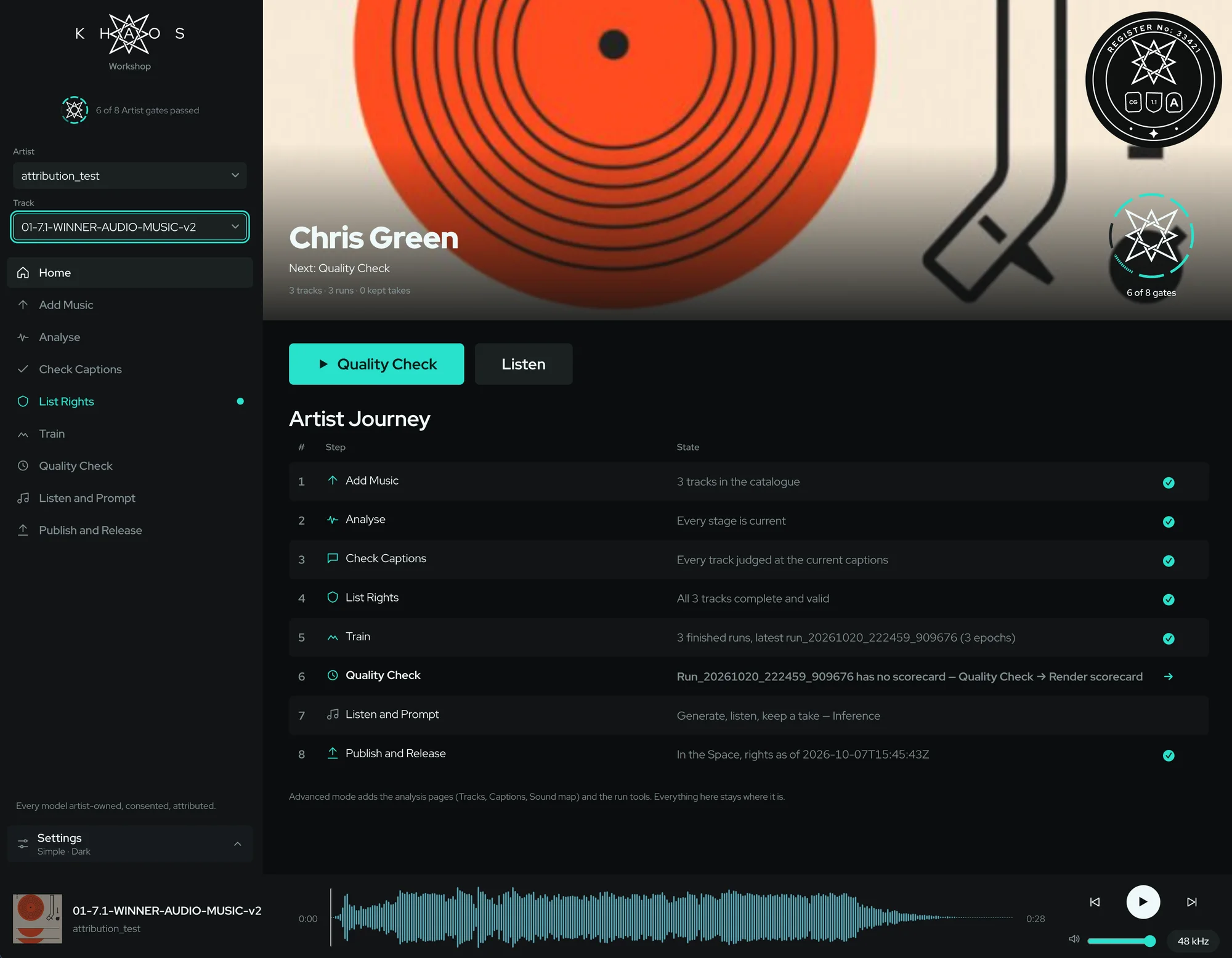
The Khaos Workshop home for one artist: the steps from Add Music to Publish and Release down the side, and the artist journey listing each step with its state.
The Workshop: one artist's journey from adding music to publishing, with what is done and what comes next.
Two

The Listening Space

A listener goes to one artist's space and prompts within that artist's sound, and hears what that artist's model makes for them. The artist sets the price and keeps the relationship with the listener.

In proof of concept, public release in 2027.

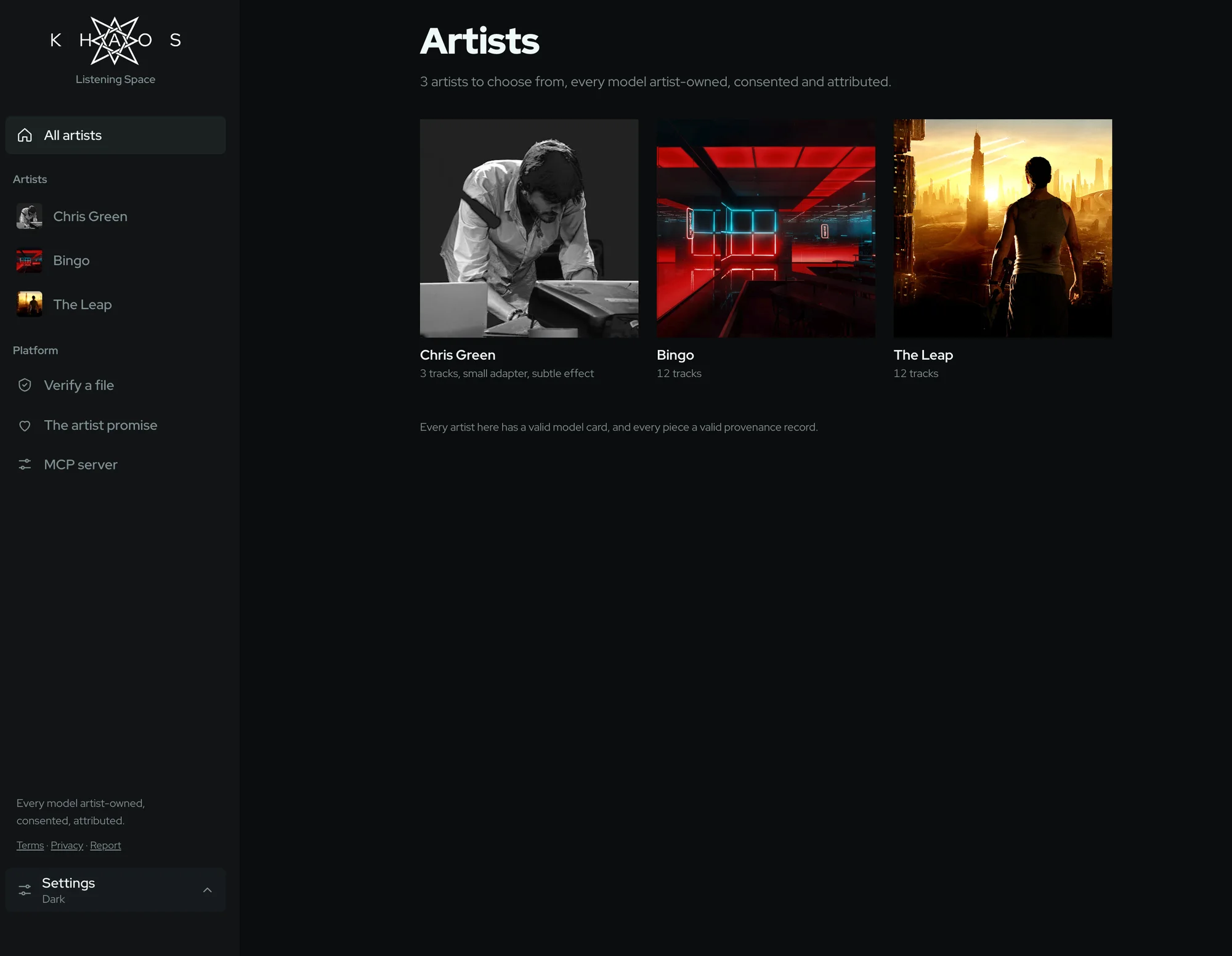
The Khaos Listening Space home, showing three artists' spaces to choose from.
The Listening Space: one space per artist.
  1. A rights map

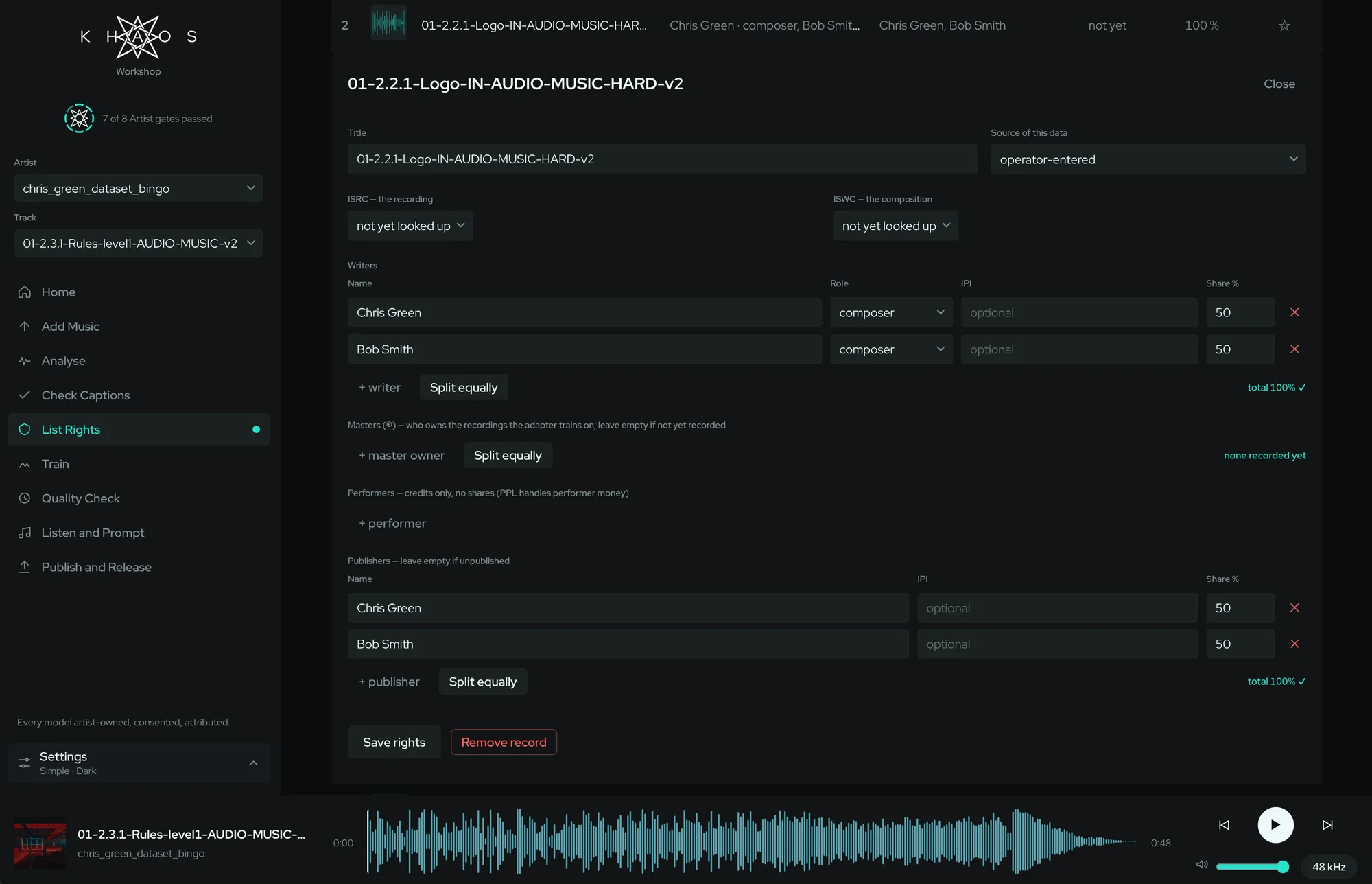
    Before anything is trained, every track is checked: who holds the master, the song, the performances. Fingerprint, ISRC and agreement checks flag anything with an uncleared co-writer, sample or session player.

    The Khaos Workshop rights form for one track: its title, ISRC and ISWC, and two writers with their roles and shares.
    The rights map in the Workshop: who wrote and published each track, and their shares. Bob Smith is test data.
  2. Written consent

    Each writer and performer is asked in writing, for this purpose only, with the right to withdraw. No default opt-ins. Those who say no are left out and lose nothing. A voice is never trained without separate consent.

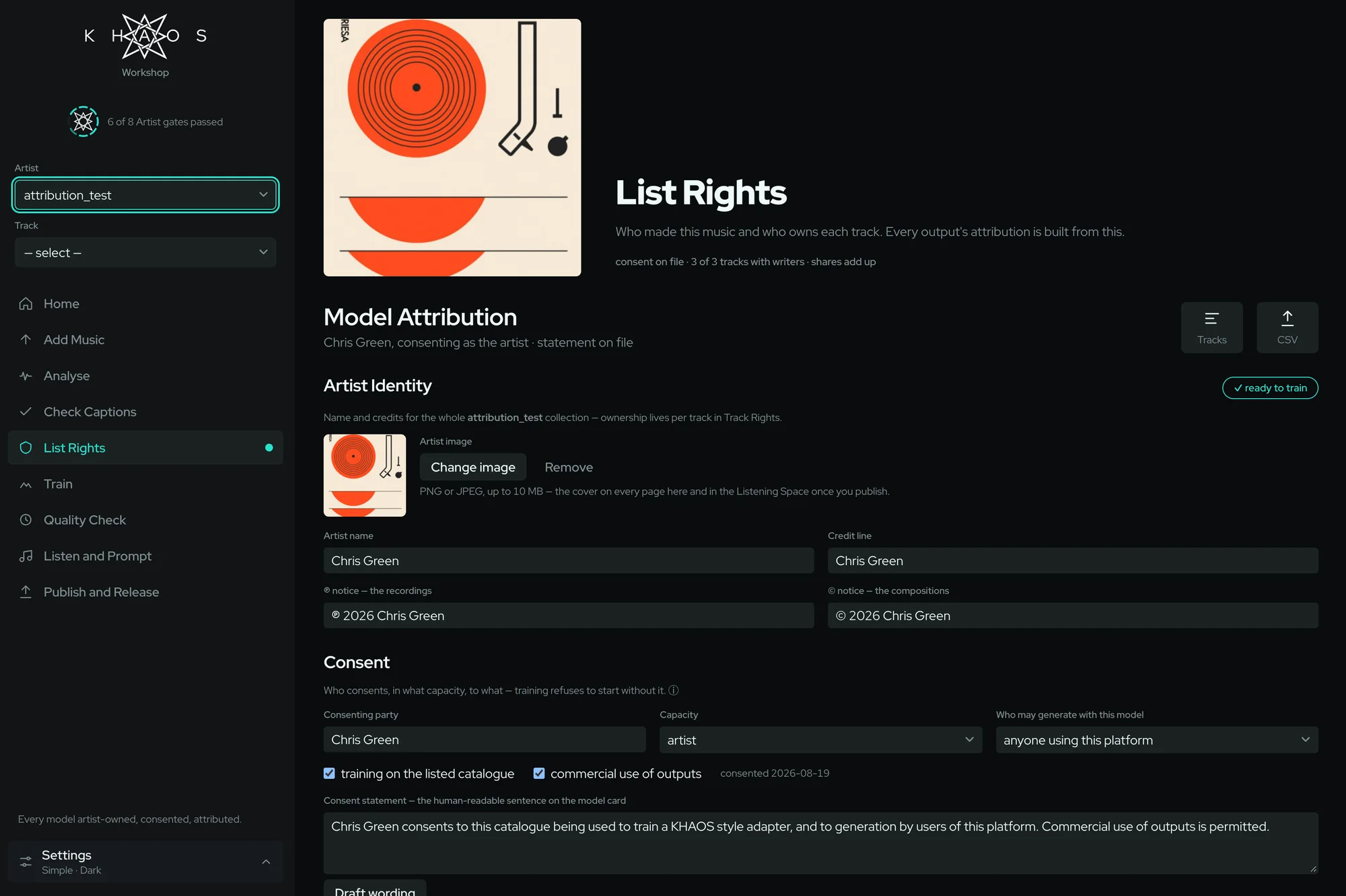
    The Workshop's consent record: the consenting party, their capacity, what they consent to and the date, with the consent statement written out.
    The consent record in the Workshop. Training does not start without it.
  3. Training on cleared tracks only

    The model trains on the artist's own machine. The catalogue goes to no third-party AI company. A usable model needs as few as eight tracks; twenty or more is better.

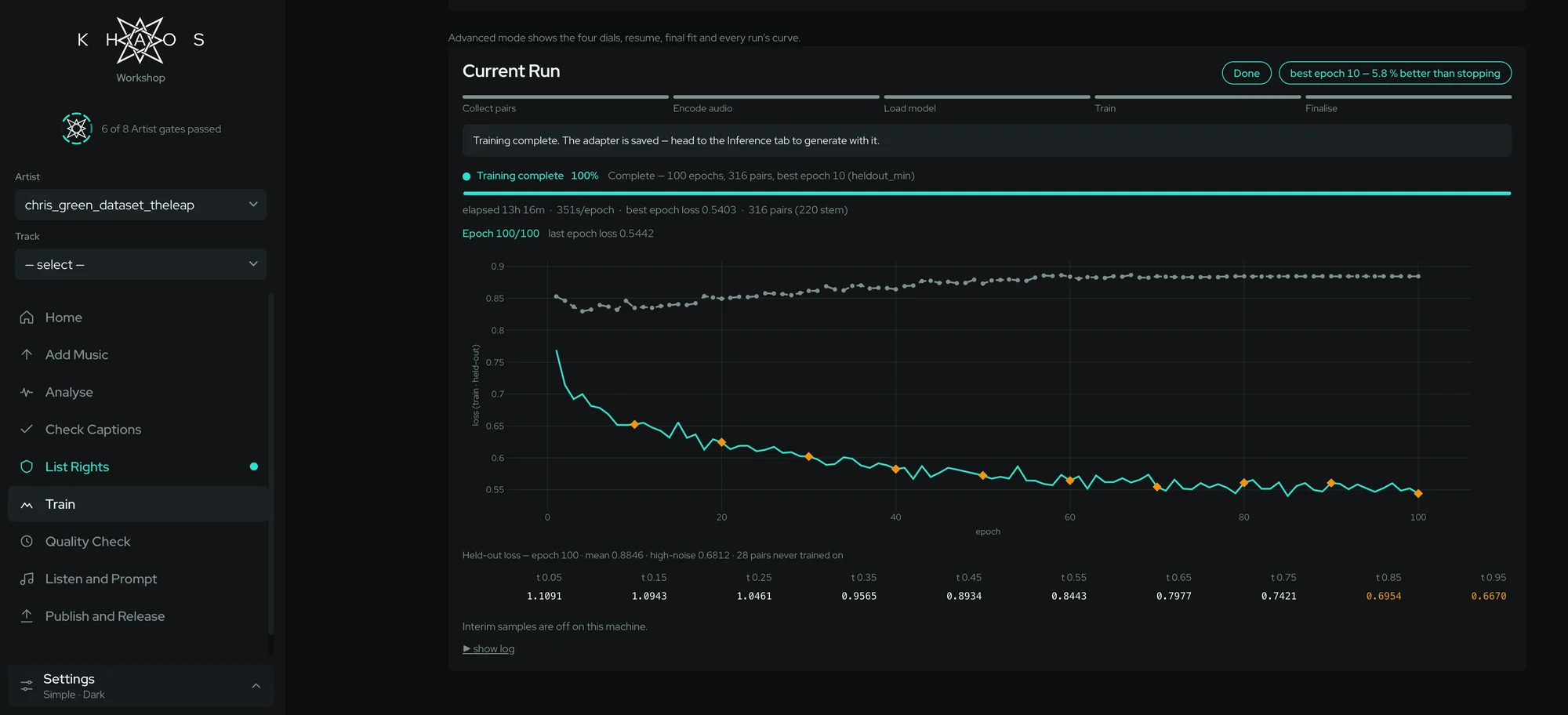
    A finished training run in the Workshop: 100 epochs over 13 hours 16 minutes, with the training and held-out loss curves and the best epoch marked.
    A training run in the Workshop, on the artist's own machine: 100 epochs over 13 hours, with the best epoch kept.
  4. Testing before release

    The model is checked for memorisation. A model that reproduces a training track is not released.

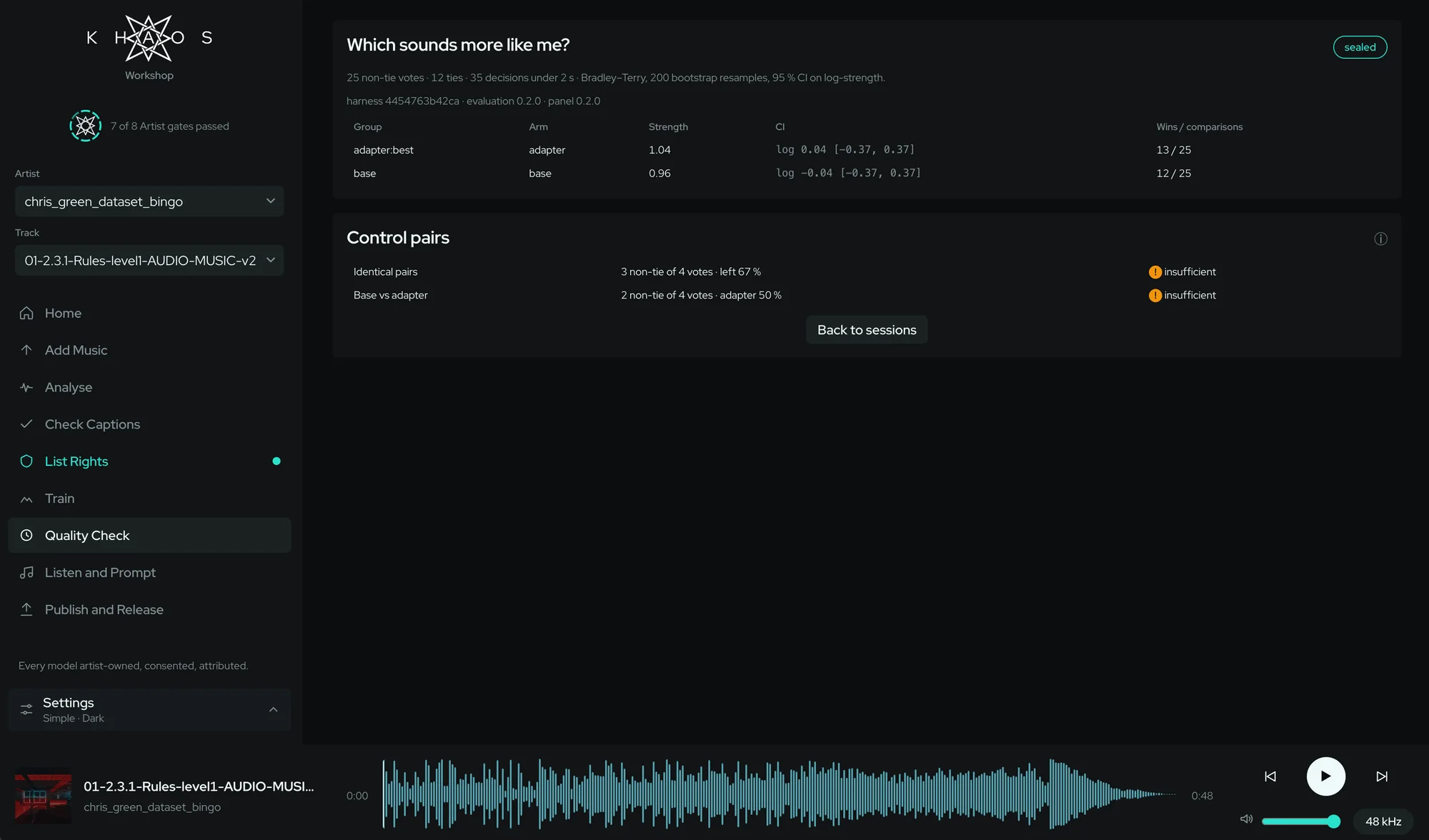
    A sealed blind listening session in the Workshop\'s Quality Check: which of two sounds more like the artist, the adapter against the base model, with the control pairs that check the panel.
    A sealed blind listening session in Quality Check: which of two sounds more like the artist, with control pairs that say whether the panel can be trusted.
  5. A room

    The model sits in the Listening Space. The owner sets what can be prompted, who gets in and what a session costs. By default nothing can be downloaded or released.

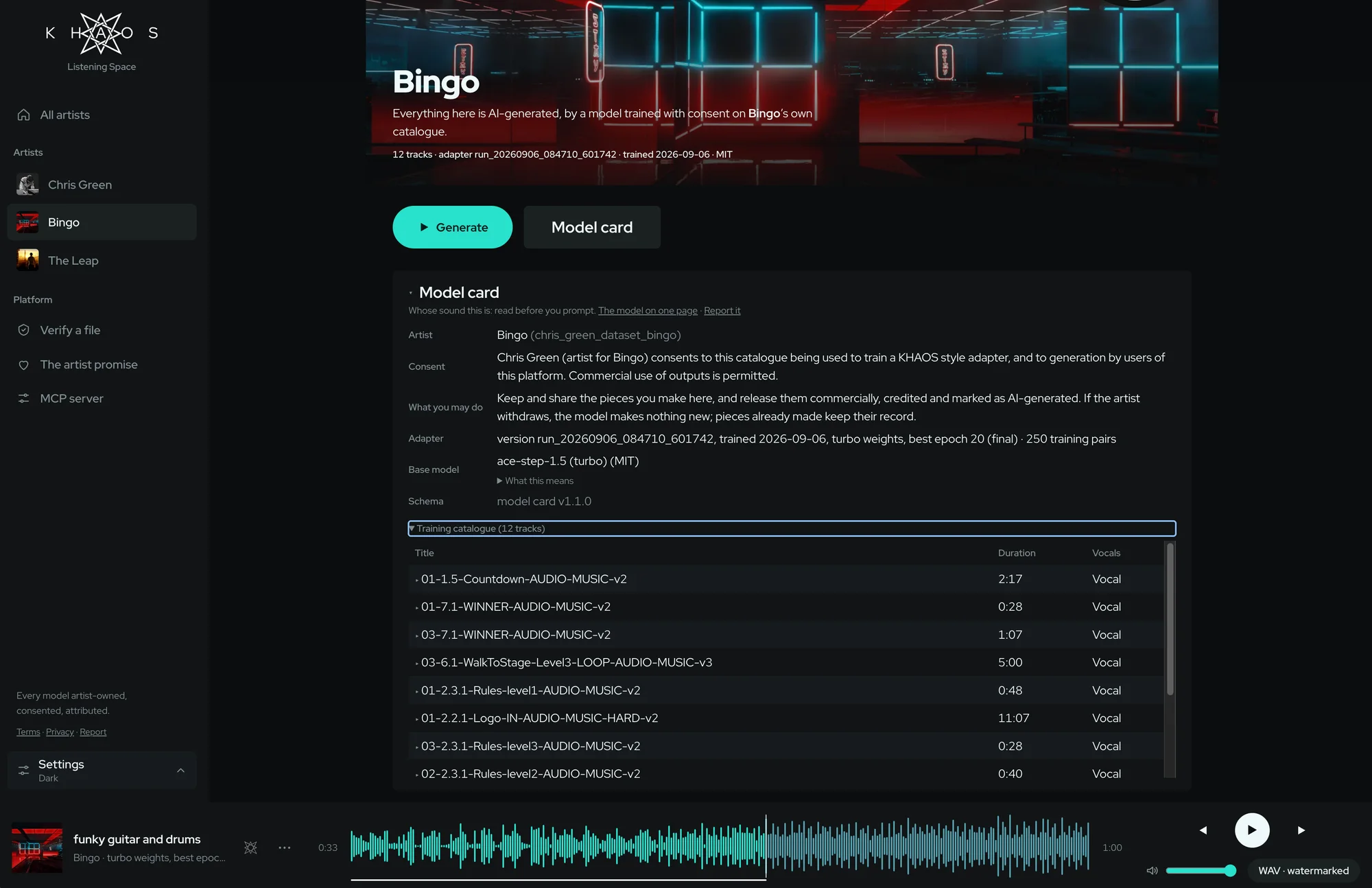
    An artist's space in the Listening Space, with the Generate button and the model card: whose sound it is, the artist's consent, what a listener may do with what they make, the adapter it was trained as, and its base model, ace-step-1.5 (turbo).
    An artist's space in the Listening Space. Its model card, read before anyone prompts, gives the consent, what a listener may do and the base model: ace-step-1.5 (turbo).
  6. Every output recorded, every share logged

    Each output is watermarked, stamped with provenance data and logged with the share each training track contributed. Statements go out each quarter, split by the attribution record.

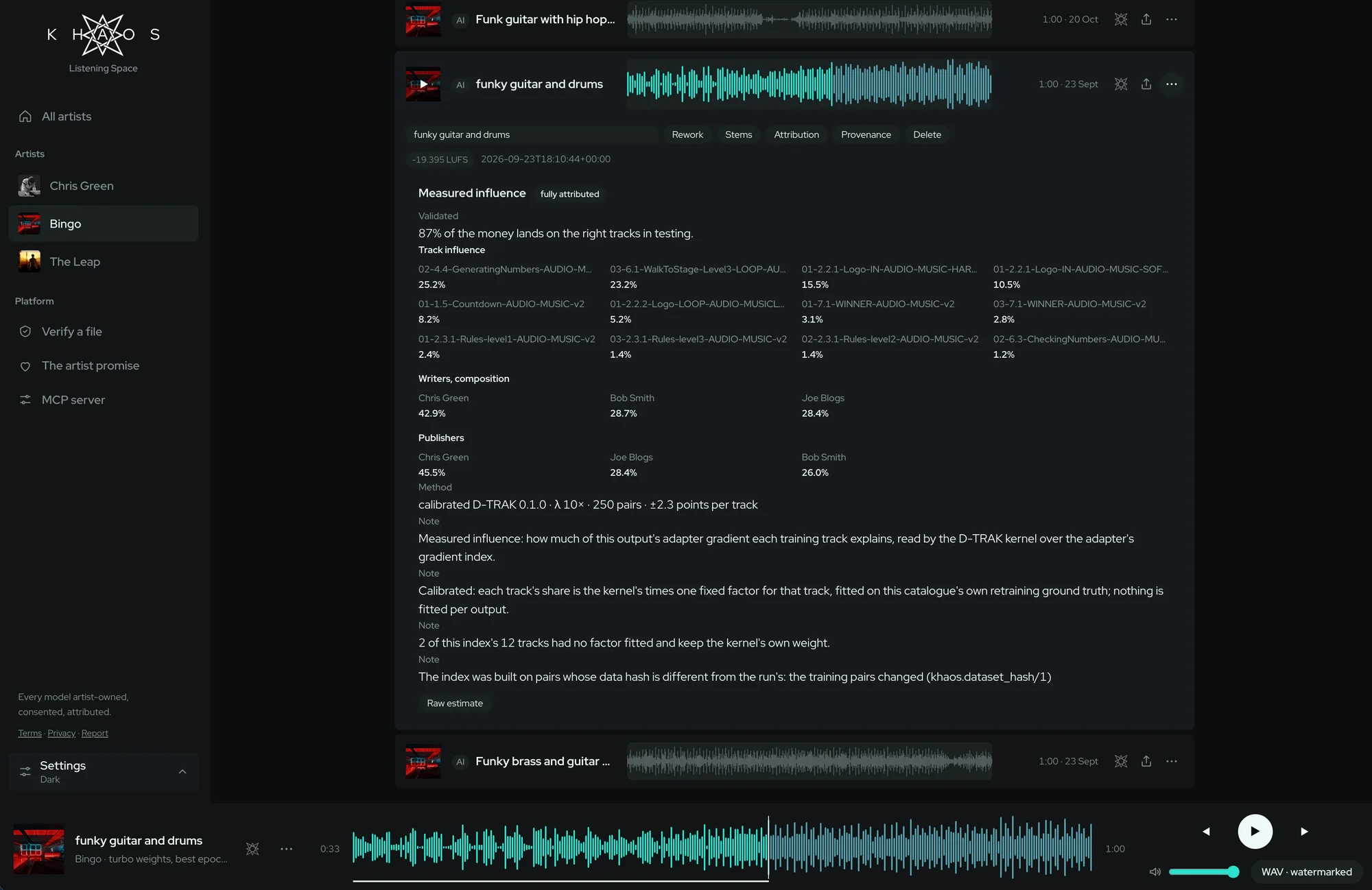
    One generated piece in the Listening Space with its measured influence from each training track and its writer and publisher splits.
    One piece in the Listening Space with its measured influence and splits. Bob Smith and Joe Blogs are test data.

Attribution that survives.

Take a piece of music made by an artist's own model. Strip the metadata, re-encode it as an MP3, and put it through everything that normally destroys provenance.

  1. MadeA piece from an artist's own model, carrying its record.Still names the artist
  2. Metadata strippedEverything outside the audio itself, gone.Still names the artist
  3. Re-encodedMP3 at 128 kbit/s.Still names the artist
  4. Level changed6 dB.Still names the artist
  5. Trimmed10% cut.Still names the artist

The attribution is still there, and it still names the artist.

Under MP3 at 128 kbit/s, a 6 dB level change or a 10% trim, no share moved by more than 0.05.

Influence

Estimated share of one output attributable to each track in the training catalogue.

  • PrizesSting72%
  • WINNER22%
  • Rules6%

Writers

How the writer share of that output divides, by the attribution record.

  • Chris Green78%
  • Bob Smith14%
  • Joe Smith7%
From the record of one piece, The MOG is in Motion, rounded to the whole percent; the record gives four places. The training tracks are real; the writer names and splits are placeholder test data. The full record, with the audio, the provenance and the signed export, is on its own page.

The split itself was tested against a retraining ground truth, with the bars set in writing before any result was scored:

  • 80p in the pound landed on the right tracks, against 70p for a flat split by data share.
  • 87–90p with per-track calibration.

These are estimates with a stated error, and the tests that failed are reported alongside the ones that passed. The working paper behind these numbers, with the method and the full results, is published here.

Every piece is marked. Anyone can check it.

Every piece of audio made with Khaos carries an inaudible watermark and a signed record saying it is AI-generated. The verifier is free to use, and answers with one of five verdicts.

Verify a fileHow it works

Confirmed

The audio matches a released Khaos piece.

Only a match in an index confirms that Khaos made a piece.

What never moves.

  • The artist owns the model, and Khaos has no claim on it.
  • No model is sold on, licensed to an AI company, or used to train another.
  • No prompts for a named artist's style without that artist's consent.

The promises are in the articles.

These promises are written into both companies' articles of association.

Khaos Foundation Limited

A non-profit company limited by guarantee. It owns the Khaos code and the attribution standard, and holds a guardian share in the operating company with a veto over any sale, change of purpose, or revision of the fee caps.

Khaos AI Ltd

The operating company. It licenses the toolkit from the Foundation and does the paid work. Its articles entrench the mission, the fee caps and the consent principles.

Khaos takes a fixed fee for work done and a capped share of what a model earns. The cap is 10% in the articles, and 5%, permanently, for the founding cohort. The rest goes to the people whose work made the model.

Alongside this sits the Guild of Fine Tuners, which certifies that a model's training data was the artist's to use, recorded on a public, hash-chained ledger.

Chris Green, Khaos Founder. A British composer and guitarist with twenty years in the music and games industries. Credits include the Hunt: Showdown soundtrack for Crytek with Port Sulphur Band, game audio for Electronic Arts and Criterion, and campaign music for the Premier League, BBC Sport and Jaguar. He sits on the board of PCAM and has taken part in Houses of Parliament roundtables on AI and creators' rights. He also runs Blurred Edge.

Khaos is a UK company, built in London.

The first step is usually a conversation and a listen: a ten-minute walkthrough of how the attribution and rights pieces work, available on request. Ask at khaos@khaos.dev.

The Revolution Will Not
Be Centralised.

Hear when there is something to try

The Workshop is a working prototype and the Listening Space is in proof of concept, both for public release in 2027. The toolkit is free to use.

Join the waitlist